












April 21, 2026
Hi Anne
 
Print Icon
 
https://campaign-image.eu/zohocampaigns/32883000001807575_1607338579635_wmca_xmas.jpg

21 April 2026

Follow us: 

Click here   for details of how to join our members WhatsApp group.


Escorting Residents and Service Users to Hospital 
Updated Guidance

Many of you will know that our WhatsApp group recently hosted a very active and constructive discussion around the issue of escorting residents or service users to hospital. This topic continues to raise important operational and safeguarding considerations for providers, and the shared experiences within the group have been incredibly valuable.


Several challenges were highlighted, including:


  • Insurance limitations, where providers may not be covered for staff to escort individuals to hospital.

  • Staffing pressures, as releasing a team member can leave services short‑staffed and potentially unsafe.

Nicola Whittingham, Registered Manager at Newbridge House Care Home in Wolverhampton, shared details in the WhatsApp group concerning a recent incident in which paramedics became rude and confrontational and insisted that a staff member accompany a resident, despite this not being feasible for them as a provider.


Situations like this underline the need for clear, consistent guidance.

https://stratus.campaign-image.eu/images/32883000025825255_zc_v1_1776162591658_newbridge_care_home.png

To support you, we now have  two updated policies  available in PDF format via the links below.


  1. A policy for Care Provider staff, outlining responsibilities, limitations, and appropriate responses when escorting is requested.

  2. A policy for patients and families, helping them understand what providers can and cannot do, and setting clear expectations.


We strongly encourage all members to familiarise themselves with these documents and refer to them whenever such situations arise.


A quick note about our WhatsApp group

This discussion is a great example of how valuable our WhatsApp group has become. It’s a safe space where members can raise issues, share experiences, and get rapid peer support on real‑world challenges. If you’re not yet part of the group and would like to join, please click on the link below — we’d be delighted to add you.


📝 Power of Attorney Day – 22 April 2026 🛡️

Power of Attorney Day   is a national campaign encouraging people to plan ahead and ensure their wishes can be protected. For many residents and service users, having a Power of Attorney in place is essential — it helps ensure the right decisions can be made about their health, welfare, and finances if they’re ever unable to do so themselves.


For care providers, supporting residents to put these arrangements in place also strengthens CQC compliance, particularly around person‑centred care, safeguarding, and ensuring people remain in control of their choices.


Through West Midlands Care Legal Services , WMCA offers care providers access to expert legal planning advice for residents and service users at very competitive rates — helping everyone stay prepared and protected. Click on the image below for more information.

https://stratus.campaign-image.eu/images/32883000025825255_zc_v1_1776257186249_power_of_attorneys.png
     

For all the latest news and updates relevant to the social care sector, check out the "News and Info" section of our website.


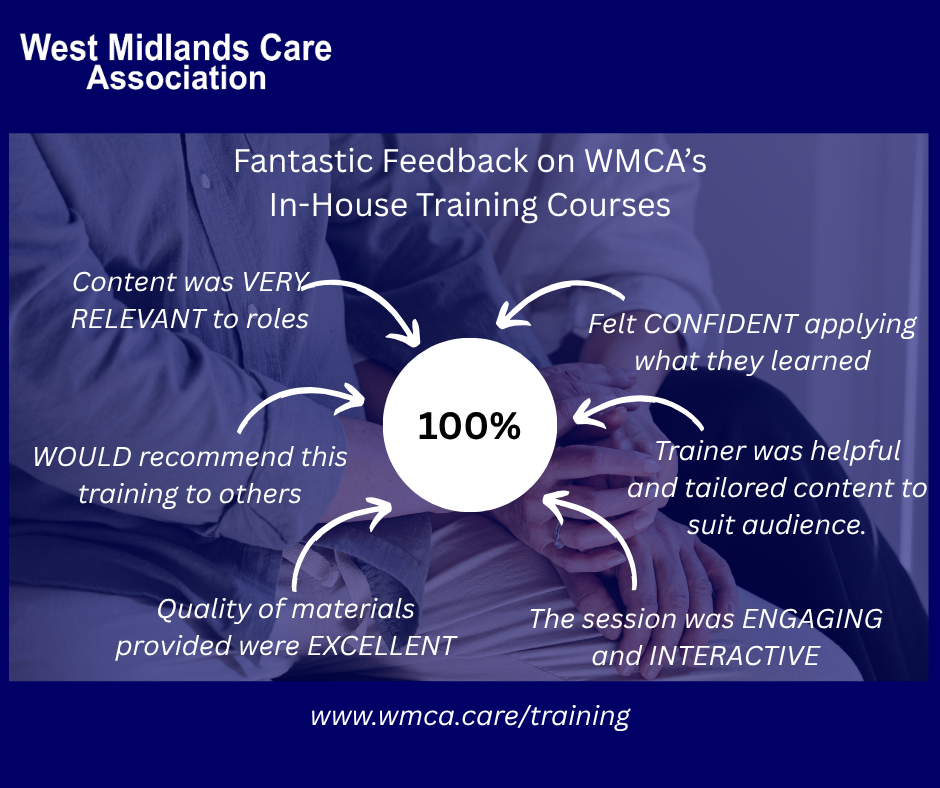
Online Training

Click on images below to find out more.

https://stratus.campaign-image.eu/images/32883000025825255_zc_v1_1775566747652_training_feedback.png
     
https://stratus.campaign-image.eu/images/32883000025825255_zc_v1_1775566434265_digital_workshops___may.png
     

Click for a full list of upcoming events


https://stratus.campaign-image.eu/images/20065281358/inkcanva_32883000021538789.png
   

Need Help completing the DSPT?

https://stratus.campaign-image.eu/images/32883000025825255_zc_v1_1752513858450_wme___wm_social_care_international_recruitment_logo.jpg

West Midlands Care Association is your local  Better Security Better Care  support organisation, offering free online resources, workshops and one-to-one support to help CQC registered providers complete the DSPT.


We also have a new offer, a free onsite, in-person  Digital Health Check .


Click the button for more info.


Our Partners

https://stratus.campaign-image.eu/images/32883000025825255_zc_v1_1746705362615_quality_of_care.png
https://stratus.campaign-image.eu/images/32883000025825255_zc_v1_1724925164254_citation.png
https://stratus.campaign-image.eu/images/32883000025825255_zc_v1_1746704926641_grace_cares_newsletter_ad.png
https://stratus.campaign-image.eu/images/32883000025825255_zc_v1_1775569512330_delphi_banner.png
https://stratus.campaign-image.eu/images/32883000025825255_zc_v1_1746704926641_grace_cares_newsletter_ad.png
https://stratus.campaign-image.eu/images/32883000025825255_zc_v1_1776163777641_syncurio_tile_(002).png
https://stratus.campaign-image.eu/images/32883000025825255_zc_v1_1724925105724_pcs.png
https://stratus.campaign-image.eu/images/32883000025825255_zc_v1_1724925176215_wm_legal.png
https://stratus.campaign-image.eu/images/32883000025825255_zc_v1_1724925188856_hcr_law.png
https://stratus.campaign-image.eu/images/32883000025825255_zc_v1_1724925254719_spectrum.png
https://stratus.campaign-image.eu/images/32883000025825255_zc_v1_1775570123785_pharmacy_xpress_banner_(2).png
https://stratus.campaign-image.eu/images/32883000025825255_zc_v1_1746705362615_quality_of_care.png
     

West Midlands Care Association  enquiries@wmca.care  01384 943000

https://campaign-image.eu/zohocampaigns/32883000002246595_1611831926057_wmca_logo.jpg
https://stratus.campaign-image.eu/images/32883000025825255_zc_v1_1753716101726_wmca_main.png
https://campaign-image.eu/zohocampaigns/32883000002246595_1611831926218_caa.jpg
 
This email was sent by news@wmca.care to an@wmca.care
West Midlands Care Association | Globe House Park Lane Halesowen B63 2RA
West Midlands Care Association 
Authorized representativeCEO  |  Email addressenquiries@wmca.care  |  Phone01384943000

Share

July 21, 2026
Amber Court Residential Care Home Turns the Tide
July 16, 2026
Care Association Alliance sets out a national funding model for adult social care, designed to give families certainty, providers stability, and councils the resources to do their job (read the full repo rt here ) A new CAA report proposes pooling the financial risk of an ageing population nationally, rather than leaving it with 153 individual councils. The core of the model: ring-fenced national funding shared on a needs-based formula, a national tariff for care, and an independent body to keep it honest. Individuals keep a means-tested contribution, but with a lifetime cap and a raised capital threshold, so no one faces unlimited costs or has to sell their home. Councils keep assessment, planning, safeguarding and oversight, but are relieved of carrying a national demographic risk on a local budget. Backed by the Rt Hon Damian Green, Chair of the Social Care Foundation and former Deputy Prime Minister responsible for social care policy. The Care Association Alliance (CAA) has published a proposal for how England should fund adult social care for older people. Its report, Adult Social Care Funding Reform, describes a national funding settlement built on a straightforward idea: the cost of growing old and needing care is a national risk, and it should be met nationally, while care itself continues to be arranged and delivered locally. A national risk carried on local budgets At present, primary responsibility for adult social care sits with 153 local authorities under the Care Act 2014. They assess need, commission services and manage local provider markets. They also carry the full financial weight of demographic change, a pressure that is national in scale and rising quickly. The number of people aged 85 and over is projected to double within twenty years, and the Office for Budget Responsibility estimates that simply maintaining today's system will require public spending on social care to grow by 3.1 per cent a year over the next decade, compared with the 0.7 per cent average delivered between 2009/10 and 2022/23. That pressure shows up directly in the price of care. On average, councils pay £24.10 an hour for home care, while the Homecare Association puts the minimum sustainable rate at £32.14. The National Audit Office found in 2021 that authorities were commissioning care at below the sustainable cost of care, and the King's Fund reports that in 2025/26, council fee increases of around 5 per cent were outpaced by provider cost increases of 8 to 10 per cent. This is not a matter of councils choosing to underpay. It is what happens when local budgets are asked to absorb a national cost. Providers take the strain through thinner margins and deferred investment, and families often meet it through the higher fees paid by those who fund their own care, on average 41 per cent more than the council-funded rate. One settlement, built as a system The CAA argues that these are symptoms of a single structural mismatch, and that they need to be fixed together. Its proposed national funding settlement rests on three principles: pooling the financial risk of demographic change nationally, a statutory entitlement to support triggered by assessed need, and continued local delivery within a national framework. In practice, the settlement has five main components: A ring-fenced national care grant , distributed to councils on a needs-adjusted formula, so that funding follows need rather than local fiscal capacity. A reformed means test , with a raised capital threshold, frozen at £23,250 since 2010/11, and a lifetime cap on what any individual can be asked to pay. A national tariff for residential and home care , set at the independently assessed cost of sustainable provision, which councils commission at or above. A bundled funding model for residential care , with assessed packages that are portable when people move. A reformed Deferred Payment Agreement scheme , so that no one is required to sell their home to pay for residential care. Underpinning the settlement is an independent National Care Assessment Body, sitting outside both the NHS and local government, which would verify the cost evidence, review the tariff and report where provision falls short. Local authorities retain their role as commissioners and delivery leaders, close to their communities and provider markets, but are relieved of being the sole bearer of national financial risk. The report is explicit about what it does not propose. This is not a free care service on the model of the NHS, and it does not absorb social care into the health service. Individuals who can contribute to the cost of their care will continue to do so, within a reformed means test and a lifetime cap. The word national describes the funding architecture, not the way care is provided. The proposal is offered as a contribution to the Casey Commission, which is beginning to test public views on who should receive care, what the state should guarantee and what individuals should contribute. The CAA says funding reform is the necessary first step, and Adult Social Care Funding Reform is the first in a programme of papers it will publish over the coming months. Melanie Weatherley MBE, Co-Chair of the Care Association Alliance, said: “No family should receive worse care because of where they happen to live, and no provider should have to choose between keeping a contract and delivering care safely. These are not failings of the people running the system. They are what happens when a national risk is carried on local budgets. If we fund care nationally, price it honestly through a national tariff, and ask an independent body to keep it that way, we can give families certainty, providers stability, and councils the resources to do the job they are asked to do. “This paper is not a criticism of local authorities, who are doing a demanding job under real pressure. It is a practical plan to put the whole system on a sustainable footing, and we hope it is useful to Baroness Casey's commission as it begins its work.” The Rt Hon Damian Green, Chair of the Social Care Foundation and former Deputy Prime Minister responsible for social care, said: “The case for reform is widely accepted. What has been missing is a workable, affordable plan that a government of any colour could adopt. This paper offers exactly that, and a cross-party route to deliver it.” (read the full report here ) ENDS Notes to editors The Care Association Alliance is the national umbrella body for local care associations in England, a member-led organisation with more than 50 local care associations, collectively representing over 10,000 independent care providers across every English region. It is a founding participant in the Care Provider Alliance. The £24.10 per hour figure is a national average local authority domiciliary care fee, not a per-council figure. It is cited alongside the Homecare Association's minimum sustainable rate (£32.14), the National Audit Office's 2021 finding on below-sustainable-rate commissioning, and the King's Fund's 2025/26 fee-versus-cost analysis, all set out in full in Adult Social Care Funding Reform (Paper One), published [DATE] 2026. Additional figures are drawn from the Health Foundation REAL Centre, the OBR, the King's Fund, the IFS and Social Care 360. The funding-gap projection runs to 2032/33. Baroness Casey's remarks were made on 7 July 2026, in a BBC Radio 4 Today interview and a speech to the Local Government Association's annual conference, in which she confirmed the Casey Commission will begin testing the views of the public this month ahead of its first report, due this year. Spokespeople are available for interview. Media enquiries: Melanie Weatherley MBE, Co-Chair of the Care Association Alliance.
July 14, 2026
Manual Handling - Train the Trainer - Last Few Spaces - Book Now!
July 10, 2026
Digital News: Scam - be aware!
July 7, 2026
New Dates for WMCA In-House Oliver McGowan Training
July 2, 2026
Preferential Member Rates on Cyber Protection Security
Show More